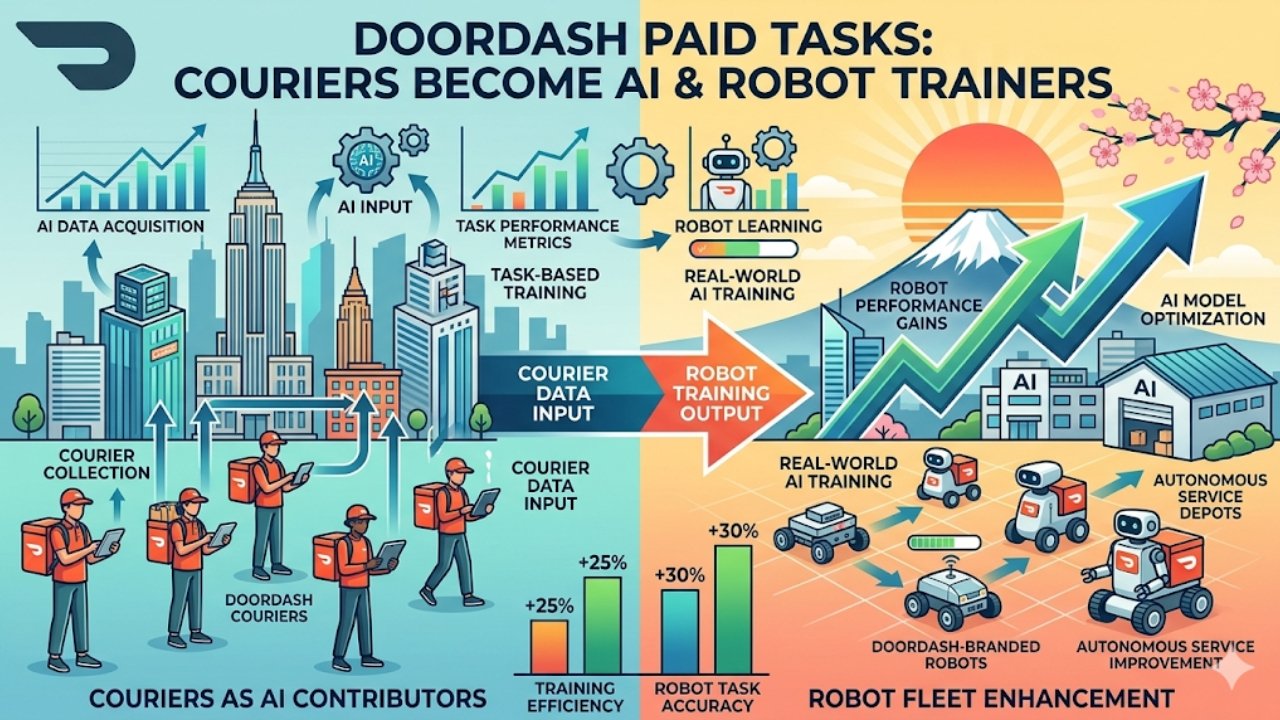
The go-to service of on-demand food delivery, DoorDash, has now given the gig economy a new spin on its courier business model. At the beginning of 2026, the company launched the program Paid Tasks that remunerates Dashers, an army of independent delivery drivers, to train AI systems and test robots. The couriers are no longer required to just deliver restaurant to door, but the extra they can achieve is taking pictures of the actual problems on the road, scoring robot navigation in the parking lot, or providing voice feedback to the delivery robots. This step is taken when DoorDash tries to attain complete automation to reduce expenses and accelerate deliveries amid tough competition with Uber Eats and increasing labour requirement. It is an intelligent game that combines human intelligence with computers to create even smarter technology right in the streets.
The Reason Gig Workers are ideal to the AI Bootcamp.
Gig employees such as Dashers are already familiar with how to manoeuvre chaos off-road; dubious pavement, unpredictable traffic, and weather. DoorDash exploited this goldmine of useful experience. Couriers are assigned tasks via the Paid Tasks app which includes photographing potholes to train a robot on how to navigate or testing a drop-off point of a drone. Quick snaps cost as little as $5 to hour-long robot supervision costing $50, which is a welcome addition to normal delivery profits. Humans are good at detecting edge cases that machines will fail to detect such as a rogue shopping cart that has blocked a curb. DoorDash also says the initial participants of its pilot program increased obstacle recognition by a quarter, which proves couriers are not only drivers but also unintentional data wizards that drive the next wave of autonomous delivery.
Robots on the Rise: DoorDash Automation Push.
DoorDash itself is not a new operation. Since 2024, it collaborated with robotics companies, such as Starship Technologies, and piloted bots walking the sidewalks in several cities in the U.S. This is enhanced by Paid Tasks which crowdsources training information on a large scale. Suppose a Dasher in Seattle sells a six-wheeled bot, and takes it down a wet alley making a note of where it gets stuck on wet leaves. Such feedback makes algorithms city-by-city. The program has been rolled out in 10 big markets- San Francisco, New York and Chicago and is planning growth everywhere by summer. According to critics, there is the concern of job displacement, although DoorDash claims it is additive since robots will carry out short-urban deliveries and humans will boost complex routes. This intermediate solution resembles that of Amazon, which has warehouse bots, but instead of being replaced, people train them.
Earnings Breakdown What Dashers can expect.
To provide an illustrative picture, the following table representing sample Paid Tasks and payouts according to the specifics of the launch of DoorDash looks as follows:
| Task Type | Description | Time Required | Average Pay |
|---|---|---|---|
| Photo Capture | Snap obstacles like curbs or signs | 5-10 min | $5-10 |
| Robot Walk-Along | Supervise bot on a short route | 30-45 min | $20-35 |
| Data Annotation | Label images for AI training | 15-20 min | $8-15 |
| Voice Feedback | Record navigation instructions | 10 min | $10-20 |
| Full Testing Session | Multi-step robot evaluation | 60+ min | $40-50 |
Such gigs enabled Dashers to increase hourly profits by 2050% during times of slow delivery. This depends on the availability per location and demand, though DoorDash focuses on high-traffic areas.
Human-AI Teams confront difficulties and their future.
It is not all smooth sailing. DoorDash anonymizes data and blurs faces, but privacy hawks raise concerns about how images are uploaded to the street. The organizers of unions lament it as digital Taylorism which transforms workers into low-wage markers. This democratizes training, however, according to an AI method of logistics anybody on a phone can be a trainer, not only PhD engineers. DoorDash records 5 000 couriers registered during the first week, which created 100,000 data points. In the future, integrations will also include AR glasses on real time feedback or Virtual training sims. Fair pay and clear rules make the difference, and when DoorDash manages to get both of them right, the concept of gig work becomes the catapult to AI careers, be it data specialist, robot wrangler.
Far-Ranging Waves in the Delivery World.
This is not looking at a vacuum- competitors are competitors with big eyes. Q1 earnings call, Uber Eats implied that it had tried to launch other similar marketplaces where people can buy tasks, and Instacart is trying shopper-led grocery picking with AI. DoorDash’s edge? The 2million active Dashers it has is an immediate work force. To consumers, it is assuring them of cheaper deliveries, faster since bots are learning what humans have tried. European regulators who are already tough on the rights of the gig workers might insist on transparency on the use of data. Nevertheless, with the program start, there is a certain reality that must be mentioned: in the age of AI technology, everyday hustlers are the key holders to the next generation of technology, one commissioned activity at a time.
FAQs
Q1: What cities have Paid Tasks?
Existing in 10 U.S hubs such as NYC and SF, and growing shortly.
Q2: Do I need special gear to join?
No- -only the Dasher app and a phone; Robots delivered on site.
Q3: Will this eliminate delivery jobs?
DoorDash has answered in the negative- it is additional revenue in addition to driving services.

