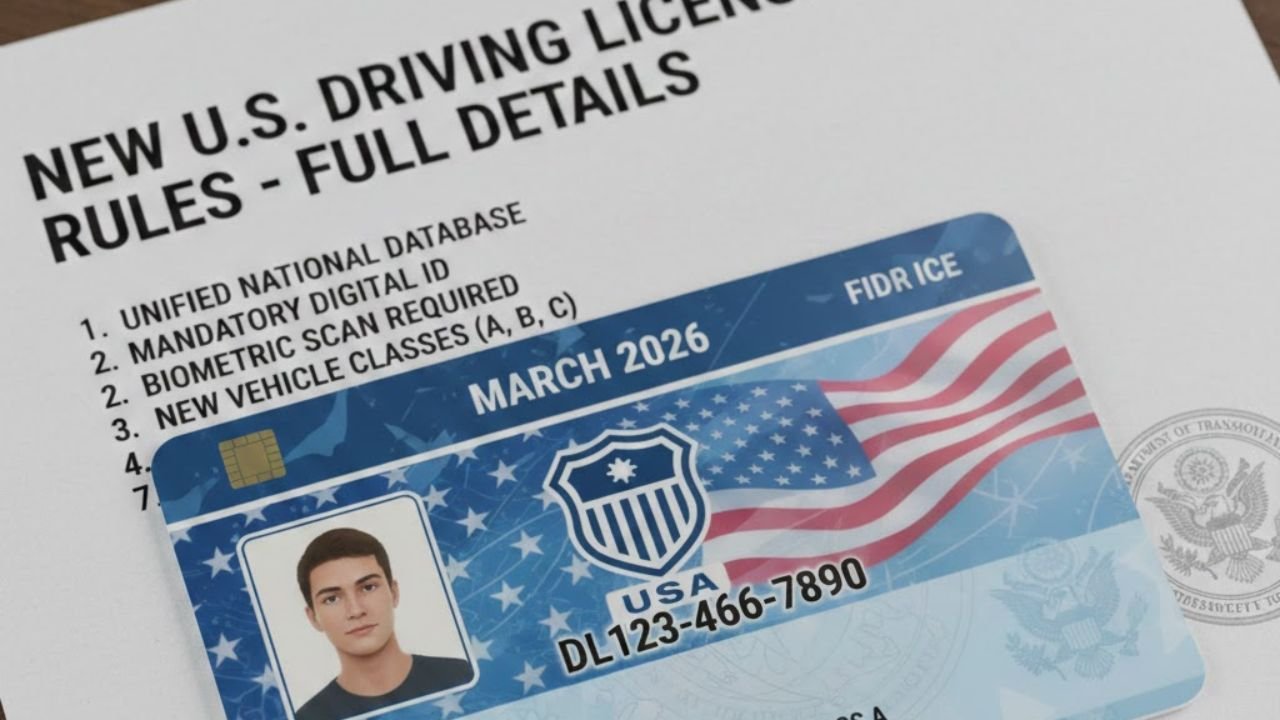
As of March 2026, new policies will impact identity verification, immigration status checks on certain commercial licenses, and driver safety requirements for new and high-risk drivers in the United States. The goal of these policies is to reduce fraud, improve safety on public roads, and align state licensing systems with federal security requirements.
More ID Checks and Security Requirements
Beginning in 2026, several states will implement updated procedures for obtaining a driver’s license in order to comply with federal REAL ID security requirements.
These stricter verification rules will require applicants to submit original documents that verify:
Full legal name
Date and place of birth
Social Security number
Two separate documents proving residency
Departments of Motor Vehicles (DMVs) will also implement federally mandated document verification systems before issuing or renewing licenses. These checks will apply to first-time applicants and to drivers who move to a new state and need to transfer their license.
Although the new procedures may require additional documentation, they are designed to significantly reduce identity theft, counterfeit licenses, and the misuse of identification cards for travel or entry into federal facilities.
New Rules for Non-Domiciled and Commercial Drivers
Another major change will take effect on March 16, 2026, specifically affecting foreign nationals who operate commercial vehicles in the United States.
Under a new Final Rule from the Federal Motor Carrier Safety Administration (FMCSA), drivers with a non-domiciled Commercial Learner’s Permit (CLP) will not be allowed to convert that permit into a non-domiciled Commercial Driver’s License (CDL) unless they can prove lawful immigration status under federal law.
The rule, titled “Restoring Integrity to the Issuance of Non-Domiciled Commercial Driver’s Licenses,” narrows the immigration categories eligible for these licenses.
This means trucking and bus companies must ensure that non-U.S. citizen drivers maintain valid immigration documentation to continue holding a CDL after March 2026.
Major Licensing Changes in March 2026
Area of Change
2026 Update
Who Is Affected
Safety Impact
Identity verification at DMV
More documentation and stronger identity checks
New applicants and renewals
Reduces license fraud and duplication
Non-domiciled CDL rules
Proof of lawful immigration status required
Foreign commercial drivers
Stronger commercial driver background checks
REAL ID enforcement
States align licensing rules with federal standards
Air travelers and federal facility visitors
More consistent ID requirements nationwide
Senior and high-risk drivers
More frequent renewals, vision tests, and in-person visits
Older or medically at-risk drivers
Helps remove unsafe drivers from the road
Effects on Senior and Medically At-Risk Drivers
Many states are also tightening driver’s license renewal rules for older drivers and individuals with medical or cognitive conditions that may affect driving ability.
Shorter license validity periods
Renewals every two or three years
Mandatory in-person renewals
Vision or medical examinations
In some states, doctors or family members may report serious medical conditions such as advanced dementia or uncontrolled seizures if they believe a driver may pose a safety risk.
However, these rules do not automatically remove licenses. Many states instead offer restricted licenses or additional driving tests so seniors can continue driving safely.
Graduated Licensing and New Driver Rules
Several states are also strengthening graduated driver licensing (GDL) systems for new drivers.
Probation periods for newly licensed drivers
Zero-tolerance policies for violations
Night-time driving restrictions
Passenger limits for teenage drivers
In some regions, curfews for new drivers may shift earlier—from 11 p.m. to 9 p.m.—to reduce risky nighttime driving.
These changes aim to reduce accidents among inexperienced drivers, who statistically face higher crash risks during their first months on the road.
What Drivers Should Do Before March 2026
Drivers should review their state DMV website to understand the exact rules and deadlines, since driver licensing remains primarily a state responsibility.
Gather original identity documents (birth certificate or passport)
Bring a Social Security card
Prepare at least two proofs of residency
Check requirements for REAL ID compliance
Commercial drivers who are not U.S. citizens should verify that their immigration documents meet FMCSA lawful-status requirements and consult their employers about the non-domiciled CDL rule taking effect March 16, 2026.
Senior drivers may also benefit from state-sponsored driving evaluations, vision tests, or defensive driving courses that demonstrate driving ability and may help reduce insurance costs.
FAQs
Q1 Do the March 2026 rules require everyone to retake a driving test?
No. Most drivers will only face stricter document verification during license renewals. New road tests will generally only be required if mandated by state law or an individual driver’s record.
Q2 How do the new rules affect foreign truck drivers?
Foreign commercial drivers must provide proof of lawful immigration status to obtain or maintain a non-domiciled CDL after March 16, 2026.
Q3 Are seniors losing their driver’s licenses?
No. Seniors will not automatically lose their licenses. However, many states will require more frequent renewals, vision tests, or medical evaluations to ensure safe driving.